
News
Latest News & Upcoming Events
The Global Seaweed Coalition is now a Foundation: a new chapter in a long institutional journey
Established under the aegis of the CNRS Foundation, the Global Seaweed Coalition now has the legal and financial framework to deepen its mission over the long term. The Global Seaweed Coalition (GSC) is pleased to announce a landmark step in its development: the...
UNGSI Co-Chairs Communiqué
UNITED NATIONS GLOBAL SEAWEED INITIATIVE Communiqué Geneva, July 13 2026, We, the members of the UN Global Seaweed Initiative (UNGSI), met in Geneva, Switzerland, on June 29 and 30, 2026, for the Initiative's first Annual Meeting. As the UNGSI takes shape as a global...

UN Global Seaweed Initiative: Annual meeting
Advancing sustainable seaweed value chains for climate, biodiversity and trade The UN Global Seaweed Initiative (UNGSI) is a multi-stakeholder platform aimed at advancing sustainable and inclusive seaweed value chains, contributing to climate action, biodiversity...

Seaweed at Scale : A Global Perspective into Implementation
Great seaweed session at the ChangeNOW Summit on April 1st in Paris ! For those who were not able to join, here’s a quick breakdown with direct links to each speaker’s segment. Michel Mortier, Executive Director of our new host, Fondation CNRS, spoke about the...
The Global Seaweed Coalition is hiring a fundraising manager
The Global Seaweed Coalition (GSC) is looking for its new fundraising manager ! The fundraising manager will work under the supervision of the GSC co-founders to raise funds to support GSC’s operations, including funds to seed innovative seaweed projects through...
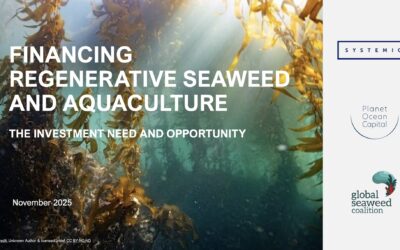
Financing Regenerative Seaweed & Bivalves Aquaculture: Launch Event
🗓️ Monday 1st December; 13.00 – 14.00 GMT Watch the replay here Join Systemiq, the Global Seaweed Coalition and Planet Ocean Capital to launch a new whitepaper: "Financing Regenerative Seaweed and Aquaculture: The Investment Need and Opportunity" ! 🔗 Register here...
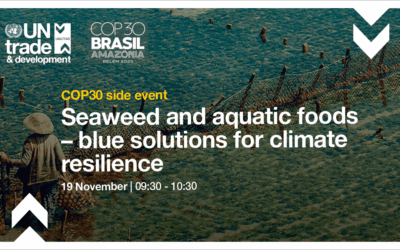
COP30 side event: Seaweed and aquatic foods – blue solutions for climate resilience
19 November 2025 09:30 - 10:30 hrs. Blue Zone, Thematic Room Location Belem, Brazil Seaweed and aquatic foods are emerging as powerful nature-based solutions to address the climate crisis, enhance food security, and support sustainable livelihoods. This event explores...
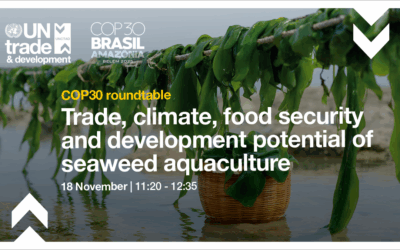
COP30 roundtable: Trade, climate, food security and development potential of seaweed aquaculture
18 November 2025 11:20 - 12:35 hrs. Auditorium A3, Agriculture and Science (Agrizone), Embrapa Amazônia Oriental Location Belém, Brazil Seaweed serves as a sustainable and nutritious food source, offering substantial environmental benefits such as carbon capture and...
Global Seaweed Coalition secures critical funding to continue its operations
The Global Seaweed Coalition (GSC) is proud to announce it has secured two years of funding to continue its operations, enabling GSC to maintain its role in promoting the safe and sustainable development of the global seaweed sector. This crucial support is provided...

A Seaweed Revolution Begins: United Nations Global Seaweed Initiative Officially Launched
New global platform unites countries and UN agencies to unlock seaweed’s potential for climate action, food security, and ocean sustainability A bold new chapter in ocean sustainability and climate action was written in New York on 23 September 2025, as the United...